SIFs: A Strategic Leap in Indian Asset Management - Will It Go the Distanc
Specialized Investment Funds (SIFs) are here and moving fast. Since going live on April 1, 2025, they have crossed Rs. 13,500 crore across 56,000-plus folios, growing nearly 7 times in eight months, with launches still coming. NISM Series 13 is the mandatory gateway to distribute them - no certification, no SIF distribution. Certified distributors have risen past 5,300 from about 2,000 early on, yet demand still outpaces supply, and every SIF with a six-month record has beaten its benchmark. This guide covers what SIFs are, what the exam tests, and how to get certified while the opportunity is still fresh.
Table of Contents
- Why SIFs Change Everything for Distributors
- How Fast India Is Adopting SIFs
- Why a SEBI RA Licence Is the Rarest Credential in Indian Finance
- Research Analyst Career Paths, Salaries and Who Is Hiring in 2026
- SIF Distribution as a Career: Scope and Growth
- What Is NISM Series 13
- Who Must Clear NISM Series 13
- Exam Structure 2026
- Syllabus 2026, Chapter-Wise Breakdown
- How to Prepare, a Proven 6-Week Roadmap
- Common Mistakes and How to Avoid Them
- After Clearing, SIF Distributor Registration Steps
- Is It Worth It, the ROI of NISM Series 13
- Frequently Asked Questions
Why SIFs Change Everything for DistributorsThe Indian investment distribution landscape just had its biggest structural shift in a decade. If you are a mutual fund distributor who has not added NISM Series 13 yet, an entire product category and a large commission pool is being distributed by someone else.
What SIFs are:
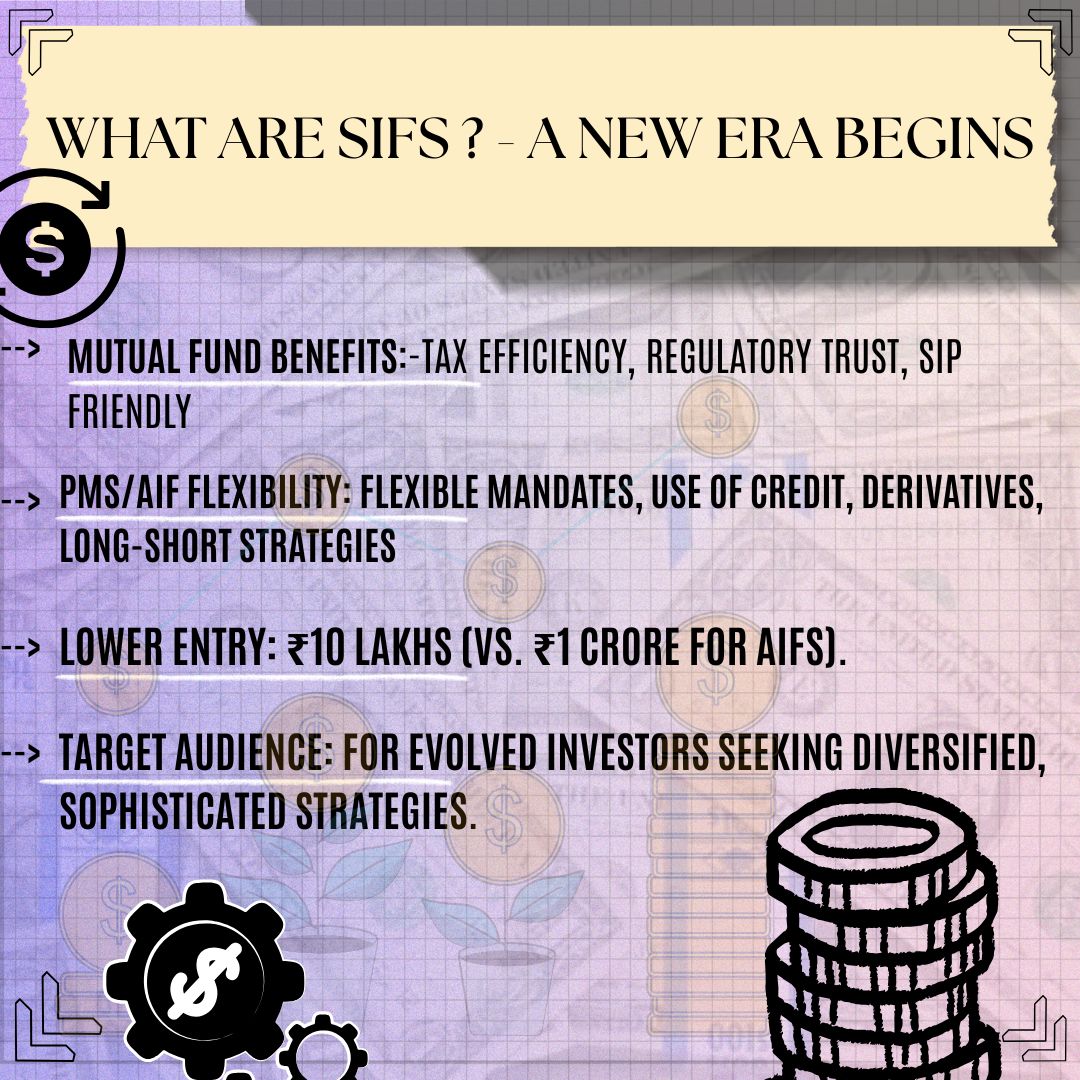
- Specialized Investment Funds went live on April 1, 2025, sitting precisely between the accessibility of mutual funds and the sophistication of PMS and AIFs.
- The minimum investment is Rs. 10 lakh per investor at the PAN level, well below the Rs. 1 crore entry barrier for AIFs.
- This is not a niche product for a handful of large clients. It is a mainstream-adjacent category aimed at India's fast-growing evolved investor segment.
What makes SIFs different, the key features:
- Derivatives exposure up to 25 percent of net assets for active views, not only hedging.
- Long-short strategies across multiple equity, debt, and hybrid sub-categories.
- Rs. 10 lakh minimum investment measured at the PAN level across an AMC's SIF strategies.
- Interval or open-ended formats with periodic redemption windows.
- Pass-through taxation, which is more efficient than the structure applied to certain alternative funds.
- Unlike leveraged alternative funds, SIFs cannot take leveraged positions using derivatives, and a single-stock exposure limit applies, keeping them closer to the mutual fund guardrails investors trust.
Why it matters for you:
- The distributor who can explain long-short strategies with confidence, because they cleared NISM Series 13, is the distributor who captures the evolved investor.
- Evolved investors are actively looking for the middle path between plain mutual funds and high-ticket PMS, and SIFs are exactly that path.
How Fast India Is Adopting SIFs
The early numbers show unusually strong appetite, and that is the real signal for distributors.
The adoption story in numbers:
- SIF assets grew nearly 7 times in roughly eight months, with the Hybrid Long-Short category leading the expansion.
- By March 2026 the category had around 14 strategies, more than 44,000 folios, and over Rs. 10,000 crore of assets, with an average ticket of about Rs. 24 lakh per folio.
- By the end of May 2026 assets crossed Rs. 13,500 crore across more than 56,000 investor folios, with over 20 strategies launched.
- The regulator itself has publicly called the investor response encouraging, pointing to a growing appetite for differentiated solutions within a well-regulated structure.
Why investors are leaning in:
- The average ticket sitting well above the Rs. 10 lakh minimum shows that investors are committing serious money, not testing the water.
- Every SIF scheme with a six-month track record has so far beaten its benchmark, which builds confidence quickly.
- Demand is spreading beyond the metros into fast-growing Tier 1 and Tier 2 cities, where a rising pool of investors now holds Rs. 10 lakh-plus investable surplus and wants more than plain mutual funds.
Why SIFs look set to be the standout product of 2026:
- A regulatory mandate, genuine product innovation, strong early performance, and a widening investor base are all pointing the same way at the same time.
- For distributors, that alignment is rare, and it is the reason the certified few are pulling ahead.
Why a SEBI RA Licence Is the Rarest Credential in Indian Finance
Here is a number that should stop you in your tracks. As of mid-2026, only around 2,067 SEBI-registered Research Analysts exist across all of India, set against a base of well over 100 million registered investors.
Why the scarcity keeps growing:
- That works out to roughly one Research Analyst for tens of thousands of investors, and the ratio has been worsening as the investor base grows faster than the analyst pool.
- The credential combines three things rarely found together: a regulatory mandate, genuine scarcity, and a strong product tailwind behind it.
- A SEBI Research Analyst registration is not just a compliance stamp. It is entry into a very small club of professionals serving an enormous market.
The crackdown on unregistered advice is your tailwind:
- A large share of retail investors still act on social-media tips, mostly from unregistered persons.
- The regulator has been systematically removing unregistered advisors and imposing penalties, which directly increases demand for licensed professionals.
- Registrations have even been cancelled for non-payment of renewal fees, showing that only active, compliant professionals keep the licence.
The infrastructure is being fortified:
- A recognised stock exchange now acts as the official Research Analyst Administration and Supervisory Body, formalising oversight.
- The consolidated rulebook covers tiered bank deposit requirements from Rs. 1 lakh to Rs. 10 lakh by client count, an annual fee cap of Rs. 1.51 lakh per family, mandatory disclosure of any AI usage, record-keeping duties, and arms-length conflict rules.
- A renewal examination creates a mandatory three-year compliance and learning loop.
- The direction is unmistakable. The licences that are hardest to get are becoming the most valuable to hold.

Research Analyst Career Paths, Salaries and Who Is Hiring in 2026
Here is what this certification does for your earnings and career trajectory.
Salary bands for a SEBI Research Analyst in India, 2026:
Career Stage | Experience | Salary Range |
Fresher or entry-level RA | 0 to 2 years | Rs. 4 to 7 LPA |
Mid-level RA | 3 to 6 years | Rs. 10 to 18 LPA |
Senior or lead analyst | 7 to 12 years | Rs. 25 to 40 LPA and above |
Buy-side leader | 12-plus years | Rs. 1.5 crore-plus total comp |
Reading the salary picture:
- The baseline salary growth forecast sits at roughly 9 percent a year through 2030, which is the conservative view.
- Active job listings consistently show Rs. 5 to 12 LPA for mid-experience roles, with buy-side positions commanding significantly higher packages.
- Add the SIF distribution commissions that certified Series 13 holders can now earn on Rs. 10 lakh-plus tickets, and the income ceiling for a certified distributor becomes genuinely exceptional.
Roles unlocked with the Research Analyst certification:
- Equity research analyst on the buy side or sell side.
- Credit and debt analyst.
- Research associate at an asset manager.
- Portfolio management service analyst.
- Independent SEBI-registered research analyst running your own practice.
- Research report writer and investment advisory associate.
Roles unlocked with NISM Series 13, the Common Derivatives and SIF distributor route:
- SIF distributor and wealth manager.
- Derivatives desk executive.
- Approved user or sales personnel for equity, currency, and interest rate derivatives segments.
- Senior mutual fund distributor adding SIF rights to an existing ARN.
- Independent financial advisor serving clients with Rs. 10 lakh-plus investable surplus.
Who is hiring:
- Global investment banks for research and structuring desks.
- Domestic broking houses and research knowledge firms.
- Asset managers and portfolio management firms across major cities.
- Fintech research desks.
- The fast-growing independent and part-time analyst segment, especially after the crackdown on unregistered advice.
SIF Distribution as a Career: Scope and Growth
Beyond the salaried analyst path, becoming a trusted SIF distributor is a career in its own right, and it is expanding quickly.
How hard is it to get the licence:
- The process is straightforward. Clear NISM Series 13, hold a valid ARN, register for SIF rights, and empanel with the asset managers offering SIF schemes.
- It is not complicated, but Series 13 is the demanding step because it draws on three derivatives modules, which is exactly why certified distributors stay scarce.
- Why the certified distributor pool is so small relative to demand:
- Certified Series 13 distributors have risen past 5,300, up from about 2,000 in the early months, but that is still tiny against a distribution industry serving crores of investors.
- The exam is the toughest and most expensive of the mainstream distributor certifications, with strict negative marking, so many mutual fund distributors have not yet crossed it.
- The gap between soaring SIF demand and this small certified pool is precisely the early-mover opening.
The value of being an early, trusted SIF distributor:
- You are utilising a client's money more effectively, using strategies that can aim for returns in both rising and falling markets and cushion some of the volatility Indian investors face.
- You are not only adding a product and a new commission stream, you are widening your service portfolio into a premium, advice-led category.
- The training ecosystem is scaling fast, with industry and institutional programmes rolling out to train thousands of distributors, and the regulator actively encouraging capability building.
A major structural change on the horizon:
- The regulator and the certification institute are jointly developing a Combined Mutual Fund and SIF Distributor Certification, a single credential that would let distributors sell both mutual fund and SIF products.
- Getting Series 13 now still positions you ahead, and it keeps you ready as the certification framework evolves.
What Is NISM Series 13
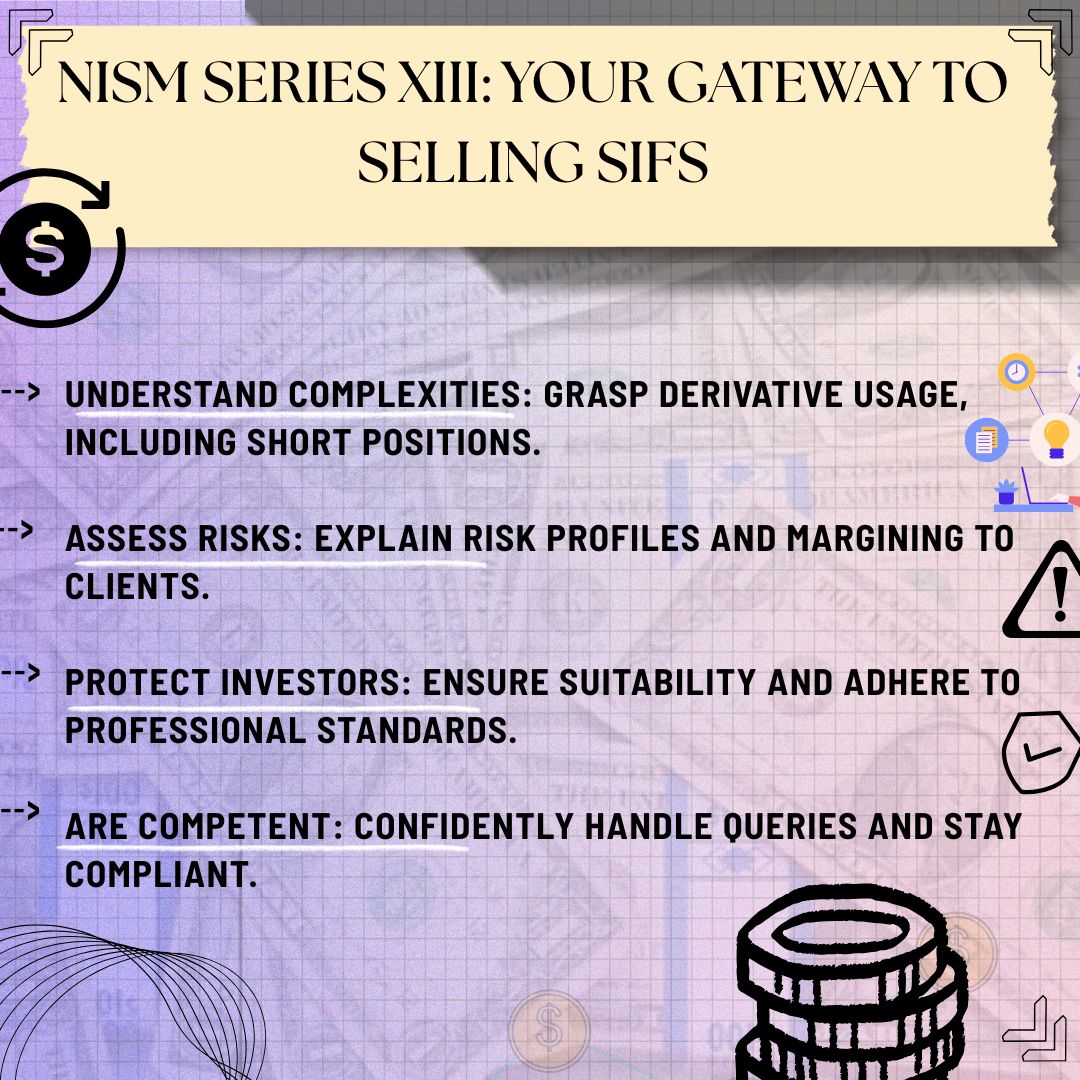
NISM Series XIII, the Common Derivatives Certification Examination, is the mandatory certification prescribed for:
Any mutual fund distributor, meaning an ARN or EUIN holder, who wants to distribute Specialized Investment Funds.
Approved users and sales personnel of trading members operating in the equity derivatives, currency derivatives, and interest rate derivatives segments of recognised exchanges.
Why it is uniquely powerful, a 3-in-1 certification:
Individual Exam | Coverage |
Equity Derivatives module | Futures, options, F and O strategies, equity underlying |
Currency Derivatives module | FX markets, regulatory framework, cross-currency |
Interest Rate Derivatives module | Fixed-income vocabulary and IRD for hybrid long-short SIFs |
Pass Series 13 once and you satisfy the knowledge requirement across all three segments.
It is a mandatory certification for SIF distribution, not an elective.
If you are weighing whether to sit a single equity module separately, Series 13 covers more ground, gives you a more versatile credential, and makes you SIF-distribution eligible in one go.
Who Must Clear NISM Series 13
Per the SEBI circular dated February 27, 2025, an entity engaged in the sale or distribution of mutual fund products is eligible to offer SIF products only if it has passed the NISM Series XIII Common Derivatives Certification Examination.
You must clear Series 13 if you are:
- An individual mutual fund distributor, an ARN holder, who wants to add SIF distribution to your practice.
- An EUIN holder attached to a firm's ARN who will interact with SIF clients.
- An employee of a distribution house engaged in SIF marketing or sales.
- An approved user or sales personnel on an equity, currency, or interest rate derivatives terminal.
- A wealth manager, financial advisor, or independent advisor with clients holding Rs. 10 lakh-plus investable surplus.
The practical detail:
- For non-individual distributor entities, at least one qualified EUIN holder who has passed Series 13 must be registered.
- You do not need a separate ARN for SIF distribution. Your existing ARN is updated with SIF rights once you pass Series 13 and pay the SIF registration fee.
Prerequisite check:
- A valid ARN or EUIN is required before applying for SIF registration.
- New applicants can apply for the ARN and SIF registration at the same time through the registrar.
- For individuals, SIF registration validity is co-terminous with the Series 13 certificate, which runs three years, not a separate fixed term.
Exam Structure 2026
Parameter | Details |
Mode | Online at test centres or remote-proctored |
Total questions | 150 MCQs |
Maximum marks | 150, one mark per question |
Duration | 180 minutes, 3 hours |
Passing mark | 60 percent, 90 out of 150 |
Negative marking | 25 percent of the marks per wrong answer, so 0.25 deducted per wrong one-mark question |
Unanswered questions | No deduction |
Certificate validity | 3 years from the exam date |
Exam fee | Rs. 3,000 plus GST |
Re-attempt | Permitted after a 7-day cooling period |
The negative-marking warning:
- The 25 percent negative marking on Series 13 is significantly stricter than some other NISM exams, so this paper punishes guesswork.
- Every wrong answer on a guessed question costs 0.25 marks and the 1 mark you could have earned, a net swing of 1.25 marks per uncertain question.
- Practical takeaway: do not attempt questions you are genuinely unsure about. Leaving a question blank costs nothing, while guessing wrong on 10 questions costs 2.5 marks. Build real conviction on the 100-plus questions you do answer.
Syllabus 2026, Chapter-Wise Breakdown
There is no single unified Series 13 workbook. The exam draws from three official modules.
Source Module | Approx Pages | Key Content |
Equity Derivatives | ~220 | F and O basics, index derivatives, stock F and O, Greeks, strategies |
Currency Derivatives | ~244 | FX markets, USD-INR products, regulatory framework, cross-currency |
Interest Rate Derivatives | ~335 | Fixed income, government securities, IRD, bond futures, hedging |
High-weightage topic areas, based on the exam pattern:
Topic Area | Estimated Weightage | Priority |
Equity derivatives, futures and options mechanics | 25 to 30 percent | High |
Trading, risk management and settlement | 20 to 25 percent | High |
Underlying markets, equity, currency, fixed income | 15 to 20 percent | High |
Currency derivatives and regulatory framework | 12 to 15 percent | Medium |
Interest rate derivatives, bond futures | 12 to 15 percent | Medium |
Regulatory framework, exchanges, SIF rules | 10 to 12 percent | High |
SIF-specific distribution rules and compliance | 5 to 8 percent | High |
Smart preparation note:
- The chapters covering clearing, settlement, and risk management repeat across all three modules with essentially the same content.
- This overlap meaningfully reduces the effective study load, so master those overlapping chapters first.
How to Prepare, a Proven 6-Week Roadmap
Adjust the pace to your derivatives background, but do not compress the first three weeks, since the foundation work there determines everything.
Week 1, foundation in equity derivatives:
- Cover the introduction to derivatives, futures mechanics, and options basics.
- Take short topic tests on futures pricing and payoffs.
- Goal: solid intuition on F and O before adding complexity.
Week 2, equity F and O strategies and Greeks:
- Options strategies such as spreads, straddles, and collars, plus the Greeks, meaning Delta, Gamma, Theta, and Vega.
- Understand the collar strategy in depth, since it is central to how many hybrid long-short SIFs are structured.
- Practise about 50 MCQs on strategies and risk profiles.
Week 3, currency derivatives:
- FX markets, USD-INR futures and options, and the regulatory framework.
- Review the shared clearing, settlement, and margin mechanics together with the equity module.
- Practise about 30 MCQs on currency topics.
Week 4, interest rate derivatives:
- Bond basics, government securities, bond futures, and duration hedging.
- This module is critical for understanding hybrid long-short SIFs with a debt component.
- Practise about 30 MCQs on fixed-income derivatives.
Week 5, regulatory framework and SIF rules:
- The SIF circular, the distributor registration process, and exchange rules.
- The Series 13 specific SIF distribution compliance content.
- Review the regulatory sections of all three modules together, as they share a lot of content.
Week 6, full mocks and weak-area revision:
- Take at least 3 full 150-question mock tests under timed conditions.
- Track your error pattern by topic for both wrong and skipped answers.
- This week is not for new content, it is for sharpening what you know.
- Target consistently scoring 100-plus before exam day, which gives a buffer above the 90-mark pass line. A useful benchmark is holding around 72 to 75 percent or higher on mocks.
Registration:
- Register online with your PAN, photo, signature, and the Rs. 3,000 exam fee.
- Slots are typically available within 5 to 7 days of registration.
- Remote-proctored and test-centre modes carry the same fee and the same certificate value.
Common Mistakes and How to Avoid Them
Treating this like a lighter version of the equity module. Series 13 spans roughly 800 pages across three modules, so plan for 4 to 6 weeks minimum, not 2.
Not respecting the negative marking. At 25 per cent, 10 wrong guesses cost 2.5 marks, and many candidates fail by a handful of marks purely because they guessed. Skip what you do not know.
Ignoring the SIF-specific regulatory sections. These are not in older standalone derivatives prep material, so use updated 2025 and 2026 resources.
Skipping mock tests. With 150 questions in 180 minutes, that is about 72 seconds per question, and untimed preparation consistently underperforms.
Waiting for more clarity on SIFs. The category is already live, growing fast, and adding new large asset managers. The wave is here, not coming.
After Clearing, SIF Distributor Registration Steps
Passing Series 13 gives you a certificate, not a distribution licence. Here is how to convert it into active SIF distribution rights.
Step 1: Pass NISM Series 13. The certificate is issued on passing, with the final PAN-linked certificate following within about 30 days.
Step 2: Ensure you hold a valid ARN, or EUIN if you are an employee. If not, you can apply for the ARN and SIF registration together through the registrar.
Step 3: Apply for SIF registration with the industry body via the registrar, per the July 2025 circular. The individual fee is Rs. 3,000 plus GST, about Rs. 3,540 in total. Your existing ARN is updated, with no new number issued.
Step 4: Get confirmation. Your ARN will show SIF rights, typically within about one business day of payment.
Step 5: Empanel with the asset managers offering SIF products.
Step 6: You are now part of a certified community of SIF distributors, serving a category that barely existed 18 months ago and is now backed by a growing list of AMCs.
Total cost for an individual, from zero to SIF-certified distributor:
- NISM Series 13 exam: Rs. 3,000 plus GST.
- SIF registration: about Rs. 3,540 including GST.
- All-in: about Rs. 6,540.
Important fine print:
- Your SIF registration stays valid only as long as your Series 13 certificate does, which is three years.
- If your ARN lapses, your SIF registration lapses automatically, even if the Series 13 certificate is still valid. Keep both current.
- If you want that preparation done right, with structured guidance and full-length mock tests built around the current pattern, Prof Sheetal Kunder Academy gets Series 13 candidates genuinely exam-ready.
Is It Worth It, the ROI of NISM Series 13
Your investment:
- Exam and registration of about Rs. 6,540 in total.
- Preparation time of 4 to 6 weeks, part-time in the evenings.
- Official study material is free, and structured coaching adds guidance and mock tests.
What you unlock:
- The right to distribute SIFs, interval and open-ended schemes with Rs. 10 lakh minimum investments.
- Commission on assets from a category that barely existed 18 months ago and already spans a growing list of AMCs.
- The ability to serve evolved, high-net-worth investors looking for the middle path between mutual funds and PMS.
- A 3-in-1 derivatives certification that also qualifies you for equity, currency, and interest rate derivatives desks.
The scarcity premium:
- With certified Series 13 distributors still in the low thousands against a distribution industry serving crores of investors, you are not joining a crowded field.
- You are joining one of the rarest licensed communities in Indian finance at the moment its core product is taking off.
The bottom line:
Regulatory mandate, market timing, product innovation, and salary growth are pointing the same way at once, which is rare.
The modest cost of accessing this opportunity is best seen as the lowest-ticket entry point into India's next wealth management frontier.


 Launch your Graphy